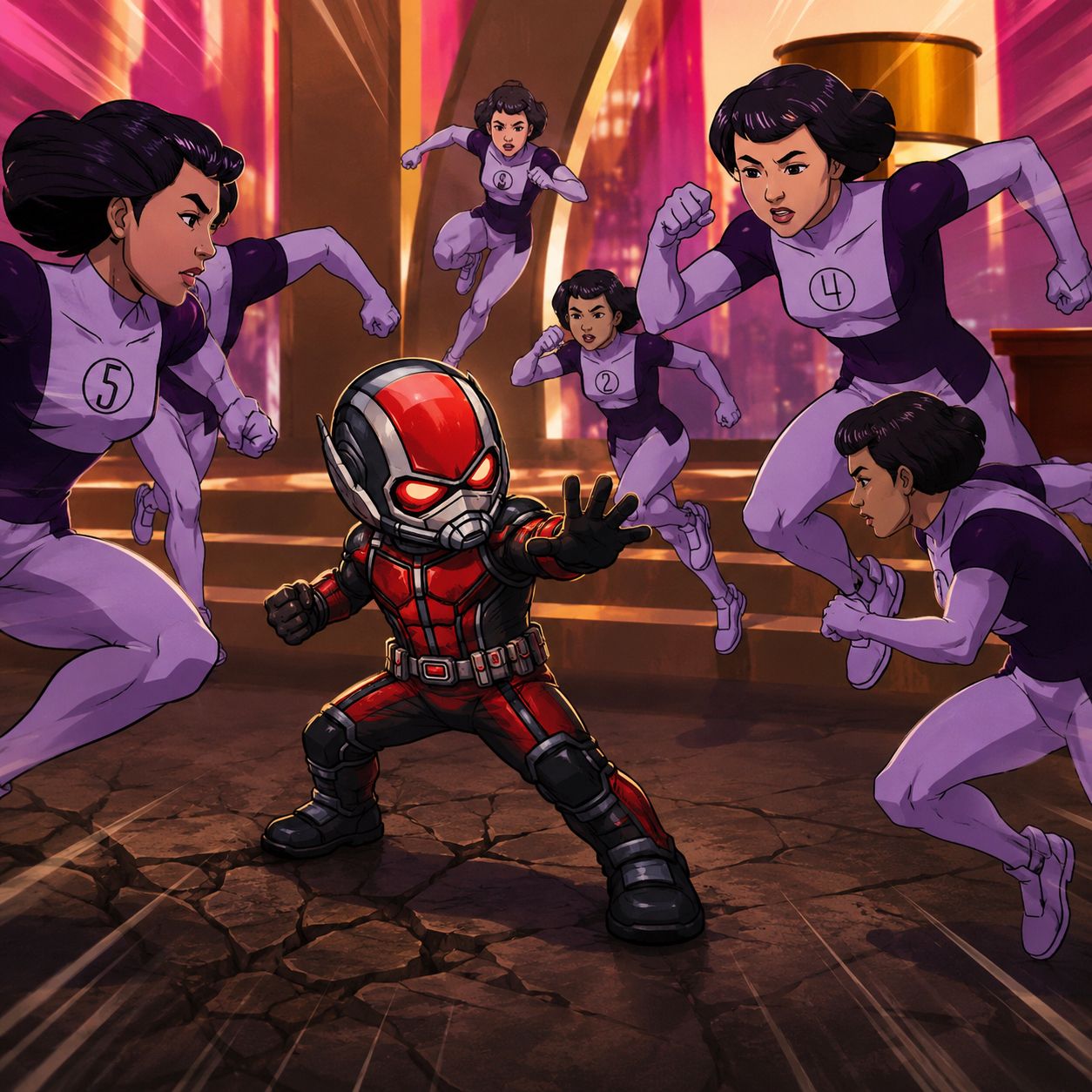
Like any tech-geek out there to a degree, I do like comic books, superheroes, Star Wars, Star Trek, the whole shebang, and this time around, I would love to draw your attention to 2 fictional characters in comic books.
Ant-Man
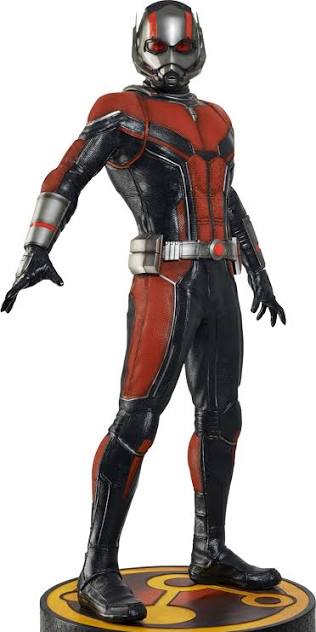
The first guy is a guy called Ant-Man who’s got this awesome bodysuit and helmet that, once put on, genetically modifies the molecular structure of his cells at the atomic level, which in turn grants him the ability to shrink his size to as small as, or even smaller than, an Ant. And it so happens he can reverse the suit’s effect to either restore him to his original height and size or extend his growth until he pretty much becomes a giant. Yes, he’s been known to grow bigger than buildings. Cool, isn’t it? He can grow or shrink. Just him
Dupli-Kate
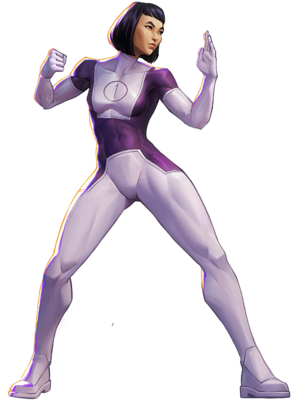
On the other hand, we got Dupli-Kate. A superhero who is kinda cool too. As her name suggests, her superpower grants her the ability to make copies of herself in tens, hundreds, or even thousands. And whenever she is done or happy with the task that warranted her self-duplication, she can just merge back into just one person. She’s got a twin brother, called Multi-Paul. And yes, he equally has the same superpower of self-duplication as she does. But he is kinda like a villain. So we’ll stick with girl power for this allegory.
So ?
As you can see, both these cool superheroes (Dupli-kate and Ant-Man) exhibit similar powers of alteration of their self-mass. Either by Ant-Man deciding that he would rather increase his mass by stretching himself as a singular unit, or by Dupli-Kate or Multi-Paul, whose version of self-expansion is the creation of multiple copies of themselves.
Huh ???
If I were to read your mind right now, you should be pondering that I am supposed to be a DevOps guy. What’s my fuss bringing up comic books and fictional characters? Then meddling them with DevOps-related conversations? For what reasons or what purpose?
Well, it turns out Dupli-Kate and Ant-Man are practically smeared in every nook, cranny, and corner in DevOps. Everywhere you turn, there is a situation that begs you to summon Ant-Man; in some cases, it’s Dupli-Kate that comes to the rescue. You need them in cloud platforms like AWS, GCP, Azure, and even virtualisation environments like VMware, or how about Nomad, or Kubernetes.. Every corner you turn, they are smack there, spilling your hot coffee over your pretty white blouse like you never saw it coming.
Still dont know what I’m talking about ..
Its easy. Im talking about a concept in DevOps called Auto-Scalling. And Auto-Scalling. works in the same principle as Ant-Man and Dupli-Kate those. Regarding that Auto-Scalling.
Ok, no more riddles ..
What is Auto-scalling ?
Autoscaling is the automated process of dynamically adjusting computing resources such as virtual machines, containers, or CI/CD pipeline agents to match real time demand. It ensures optimal application performance during traffic spikes while scaling down during quieter periods to minimize cloud costs.
Types of Autoscaling
Systems can scale in two distinct ways to handle workload variations:
Dupli-Kate AKA Horizontal Scaling (Scale Out/In): Adding or removing the number of identical server instances or containers. This is the standard method for cloud-native applications.
Ant-Man AKA Vertical Scaling (Scale Up/Down): Increasing or decreasing the capacity of an existing server (e.g., upgrading RAM or CPU). Because this often requires temporary downtime, it is less commonly automated.
How Autoscaling Works
Autoscaling operates via user-defined policies and metrics to automate the lifecycle of compute resources. It typically relies on the following components:
Metric Thresholds: Monitoring services (such as Prometheus, Datadog, or AWS CloudWatch) continuously track parameters like CPU utilization, memory usage, or network traffic.
Minimum/Maximum Limits: Engineers define a floor and ceiling for resources so systems can scale outward without spiraling out of control financially.
Automated Actions: When a threshold is breached (e.g., CPU usage exceeds 70% for 5 minutes), the autoscaling engine automatically provisions or terminates instances.
Common Tools
To implement autoscaling in your own infrastructure, DevOps teams frequently leverage the following services:
Cloud Provider Services: AWS Auto Scaling, Microsoft Azure Autoscale, and Google Cloud Autoscaler.
Container & Kubernetes Orchestration: Kubernetes features tools like the Horizontal Pod Autoscaler (HPA) and KEDA to scale container replicas based on specific workload events.
Infrastructure as Code (IaC): Tools like Terraform and Ansible are used to write autoscaling policies as code, making environments repeatable and reliable.
SO, back to the fuss about our heroes Ant-Man & Dupli-Kate
Like I said, The fuss about Ant-Man and Dupli-Kate came about by virture of their expansion.
Ant-Man grows upwards, vertically towards the sky. Thats pretty much tantamount to scaling-up and scaling-down, which are atributes of vertical scaling.
The same goes for Dupli-Kate. By virture of her self-replication, spreading herself accross the horizon, She exhibits the atributes of scaling-out and scaling-in which is pretty much horizontal scaling
Lets try put it in some examples.
If we use AntMan to represent vertical scaling and Dupli-Kate to represent horizontal scaling, auto-scaling can be understood as a system that automatically adjusts resources based on demand.
1. Vertical Auto-Scaling (Ant-Man Model)
Think of Ant-Man as a single server that can grow or shrink in size.
Normal Traffic
One server:
- 2 CPUs
- 4 GB RAM
CPU utilization: 30%
Everything runs normally.
Traffic Spike
Suddenly, 10,000 users visit the application.
The auto-scaling system detects:
- CPU utilization > 80%
- Memory utilization > 75%
Instead of creating new servers, it upgrades the existing server: Basically scaling-up
| Before | After |
|---|---|
| 2 CPUs | 8 CPUs |
| 4 GB RAM | 16 GB RAM |
.
Like Ant-Man returning to normal size. Basically scaling-down
Advantages
- Simpler architecture.
- No need for load balancing.
Challenges
- There is a maximum size a server can reach.
- Scaling may require a restart or cause brief disruption depending on the platform.
2. Horizontal Auto-Scaling (Dupli-Kate Model)
Think of Dupli-kate as the ability to create multiple copies of the same server.
Normal Traffic
You start with:
  Load Balancer
      |
   Server-1
CPU utilization = 30%.
Traffic Spike
Demand increases dramatically.
The auto-scaler detects:
- Average CPU > 70% for 5 minutes
Instead of making Server-1 larger, it creates copies:
           Load Balancer
         /      |      \
   Server-1 Server-2 Server-3
Requests are distributed across all servers.
Like Dupli-Kate creating clones of itself to share the workload. Basically scaling-out
Larger Spike
Traffic continues increasing:
                Load Balancer
      /      /      |      \      \
    S1      S2      S3      S4     S5
The auto-scaler keeps adding instances until the load returns to acceptable levels. Meaning it keeps scaling-out
Traffic Drops
When CPU utilization falls below 30%:
  Load Balancer
      |
   Server-1
Extra instances are automatically terminated.
Like Dupli-kate’s clones disappearing when they are no longer needed. Basically scaling-in
Advantages
- Virtually unlimited scaling.
- Better fault tolerance.
- No single server bottleneck.
Challenges
- Requires stateless application design.
- Needs load balancing and distributed storage/session management.
3. Real Cloud Example
Suppose an e-commerce application is running on Amazon Web Services (AWS).
AntMan (Vertical Scaling)
At 9 AM:
- EC2 Instance
- 2 vCPU
- 4 GB RAM
- EC2 Instance
At 12 PM during a flash sale:
- EC2 Instance
- 16 vCPU
- 64 GB RAM
- EC2 Instance
The same machine becomes more powerful.
Dupli-kate (Horizontal Scaling)
At 9 AM:
- 1 EC2 Instance .
At 12 PM:
- 10 EC2 Instances
behind an Elastic Load Balancer
The workload is spread across multiple identical servers.
4. How Auto-Scaling Makes Decision
A typical rule might be:
Scale Out:
If CPU > 70% for 5 minutes
Add 1 instance
Scale In:
If CPU < 30% for 10 minutes
Remove 1 instance
Example Timeline
| Time | Users | CPU | Action |
|---|---|---|---|
| 09:00 | 500 | 25% | No action |
| 10:00 | 2,000 | 75% | Add instance |
| 10:05 | 5,000 | 80% | Add another instance |
| 10:10 | 10,000 | 85% | Add another instance |
| 13:00 | 1,000 | 20% | Remove instance |
| 14:00 | 500 | 15% | Remove another instance |
.
This is auto-scaling: monitoring workload metrics and automatically increasing or decreasing resources.
Summary
| AntMan (Vertical Scaling) | Dupli-kate (Horizontal Scaling) |
|---|---|
| Makes one server bigger | Creates more servers |
| Scale up/down CPU & RAM | Add/remove instances |
| Easier to manage | More resilient |
| Limited by hardware size | Can scale almost indefinitely |
| Example: 2 CPU → 16 CPU | Example: 1 server → 10 servers |
.
Auto-scaling can use AntMan scaling, Dupli-kate scaling, or a combination of both. Many modern cloud-native applications prefer the Dupli-kate approach because it provides higher availability and elasticity.